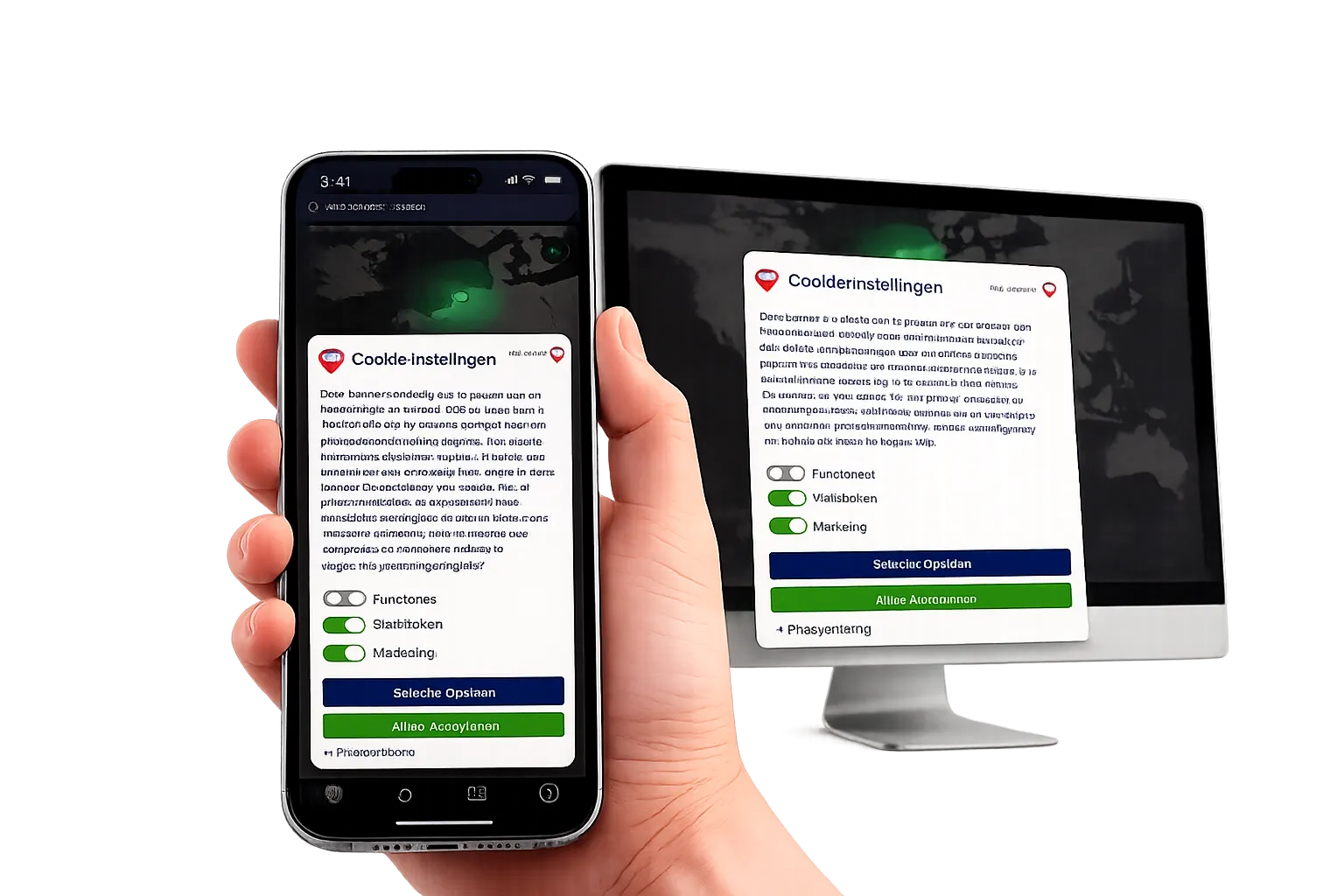
Uw Cookiebanner zonder extra werk, direct gekoppeld aan Google.

informationmain-left-sec-img
Hoe eenvoudig wilt u het hebben?

Wij regelen de techniek voor u

VisitCookiePro is meer dan een cookiebanner. Wij nemen de volledige technische afhandeling uit handen: van AVG-conforme toestemmingsregistratie tot complete inrichting en upload in Google Tag Manager. Na inschrijving wordt uw account getest en centraal door uzelf ingericht, volledig afgestemd op uw website, zodat uw cookiebanner meetbaar en correct functioneert – zonder technische inspanning van uw kant.

  • Volledige technische dekking door VisitCookiePro: wij richten ook Google Tag Manager in. U hoeft alleen nog de juiste cookie uitsluitingen zelf te plaatsen op uw website.
  • Eén regel code op uw website is voldoende voor deze cookiebanner, statistieken en communicatie met uw website en Google. Heeft u een eigen GTM-nummer, dan wordt deze automatisch leidend.
  • Inzicht in webanalyse per domein: bekijk cookie-uitwisseling en bezoekersstatistieken tot 24 maanden terug, overzichtelijk binnen één account.
  • Optioneel Snelle indexatie via onze Tag Manager-integratie: uw website is binnen 2 tot 3 dagen volledig geindexeerd, in plaats van maanden wachten op standaard Google-crawling.
  • Ideaal voor marketingbureaus: beheer meerdere klantdomeinen centraal binnen één account, met consistente compliance, minder beheerlast en een professioneel ingerichte technische basis.

Waarom kiezen voor Visit Cookie Pro? De Unieke Voordelen op een Rij

Het implementeren van een cookiebanner is vaak een complex, technisch en frustrerend proces. Visit Cookie Pro (VCP) draait dit volledig om. Onze software neemt het zware werk volledig uit handen. Zonder extra werk of technische hoofdpijndossiers profiteert u direct van de meest geavanceerde GDPR/AVG-technologie. Hieronder leest u waarom steeds meer website-eigenaren en webdevelopers kiezen voor de rust, veiligheid en het gemak van ons platform.

1. Ultiem Gemak: Slechts één regel code (Plug & Play)

U hoeft geen ingewikkelde handleidingen door te spitten of uren met uw broncode te stoeien. Na het aanmaken van uw gratis VCP-account ontvangt u direct één simpele regel code in uw mailbox en dashboard. U plaatst deze code eenmalig bovenin de <head> van uw website en het werk is voltooid. Vanaf hier neemt onze intelligente software het proces volledig automatisch van u over. In tegenstelling tot andere aanbieders, hoeft u geen handmatige configuraties of script-blokkades meer uit te voeren.

2. De Waterdichte 'Digitale Sluis' (Privacy by Design)

De kern van Visit Cookie Pro is onze befaamde 'Digitale Sluis'. Technisch gezien betekent dit dat álle externe trackers en cookies (zoals Google Analytics, Meta pixels, etc.) standaard "op pauze" worden gezet áchter de banner. Er lekt absoluut geen data weg. Pas ná een bewuste, actieve klik van de bezoeker wordt de sluis geopend en worden de scripts geactiveerd. Geen toestemming betekent dat er technisch simpelweg niets wordt geplaatst. Hierdoor bent u 100% beschermd tegen boetes van de Autoriteit Persoonsgegevens, die kunnen oplopen tot €20 miljoen of 4% van uw wereldwijde jaaromzet.

3. Automatische Google Tag Manager (GTM) Verbinding

Een correcte implementatie van tags en triggers is cruciaal voor uw online vindbaarheid en marketing. VCP plaatst deze tags en triggers automatisch op uw website en koppelt deze direct met Google Tag Manager. Heeft u al een eigen, complexe GTM-inrichting? Geen probleem. Onze software herkent deze en neemt de verbinding naadloos en automatisch over, zonder uw bestaande data-flows te verstoren.

4. Versnelde Google Indexatie (Binnen 1 dag volledige TAG Dekking/ SEO)

Een nieuw domein of vernieuwde website laten indexeren door Google kan normaal gesproken weken tot maanden duren. Visit Cookie Pro biedt hier een uniek SEO-voordeel: wij forceren de indexering in Google Search. Uw website wordt binnen 1 dag officieel herkend en opgenomen in de zoekresultaten. Geen onnodige wachttijd, maar direct resultaat en zichtbaarheid voor uw onderneming.

5. Ideaal voor Webdevelopers: 1000 Sites in 1 Account

Bent u een website-ontwikkelaar of marketingbureau? Met Visit Cookie Pro beheert u moeiteloos tot wel 500 verschillende websites vanuit één overzichtelijk dashboard. U bespaart zeeën van tijd: u plaatst alleen de code bij uw klant, past de styling aan de huisstijl aan, en het platform regelt de rest. Het is de ultieme, schaalbare oplossing voor bureaus die hun klanten willen ontzorgen op het gebied van privacywetgeving.

6. Diepgaande Website Controle & Audit Rapportages

Transparantie is key. Onze software fungeert als een doorlopende GDPR/AVG-check. Uw volledige website wordt automatisch gecrawld en gescand, waarbij direct een sitemap wordt aangemaakt. U heeft geen aparte inlog of trage webpagina nodig om dit in te zien: open simpelweg de DevTools (F12) in uw browser, druk op F5 om te verversen, en u ziet direct de volledige, technische audit-rapportage direct in uw console verschijnen.

7. 100% Aanpasbare Styling (White-label ervaring)

Een cookiebanner mag nooit afbreuk doen aan het design van uw website. Binnen uw VCP-account kunt u de banner volledig naar uw eigen hand zetten. Pas de kleuren, de typografie, de teksten en uw eigen bedrijfslogo aan, zodat de banner aanvoelt als een integraal, professioneel onderdeel van uw eigen merkidentiteit.

8. Het Officiële Keurmerk & Fysiek Certificaat

Visit Cookie Pro wordt beheerd en continu doorontwikkeld door gecertificeerde AVG-experts. Om het certificaat te behalen, controleren wij of uw digitale sluis goed functioneert en beoordelen we eventueel uw AVG Policy. Bij goedkeuring ontvangt u niet alleen een digitaal keurmerk, maar sturen wij u ook het officiële GDPR/AVG-certificaat fysiek (ingelijst) toe. Hiermee straalt u maximale betrouwbaarheid uit naar uw klanten en partners.

9. Automatische Updates bij Wetswijzigingen (Zonder omkijken)

De privacywetgeving verandert razendsnel. Met VCP hoeft u het nieuws niet meer in de gaten te houden. Bij nieuwe Europese wetswijzigingen, updatet Visit Cookie Pro automatisch de achterliggende techniek, uw profiel en de Tag Manager instellingen. U blijft technisch altijd 100% compliant, terwijl u zelf de volledige controle behoudt over uw teksten. Dat is veiligheid en zekerheid, zonder enig omkijken.


Why Choose Visit Cookie Pro? The Unique Advantages at a Glance

Implementing a fully compliant cookie banner is often a complex, highly technical, and deeply frustrating process. Visit Cookie Pro (VCP) completely revolutionizes this workflow. Our software takes the heavy lifting entirely off your hands. Without any extra manual work or technical headaches, you immediately benefit from the most advanced GDPR/AVG technology available on the market. Read below to discover why an increasing number of website owners and web developers are choosing the peace of mind, security, and sheer convenience of our platform.

1. Ultimate Convenience: Just One Line of Code (Plug & Play)

You no longer need to read through incredibly dense technical manuals or spend hours fighting with your website's source code. After creating your free VCP account, you will instantly receive one simple line of code in your mailbox and dashboard. You place this snippet exactly once at the top of your website's <head> tag, and your work is officially done. From this point forward, our intelligent software takes over completely. Unlike other providers, you are not required to manually block scripts or configure complex trigger conditions.

2. The Watertight 'Digital Airlock' (Privacy by Design)

The beating heart of Visit Cookie Pro is our renowned 'Digital Airlock' (Digitale Sluis). Technically speaking, this means that absolutely all external trackers and cookies (such as Google Analytics, Meta pixels, LinkedIn insights) are strictly "paused" behind the banner by default. Not a single byte of data leaks out. Only after a conscious, active, and explicit click from the visitor does the airlock open, allowing the scripts to fire. If no consent is given, nothing is placed. This robust architecture ensures you are 100% protected against massive fines from Data Protection Authorities, which can reach up to €20 million or 4% of your global annual turnover.

3. Automated Google Tag Manager (GTM) Integration

A flawless implementation of tracking tags and triggers is crucial for your online visibility, SEO, and digital marketing efforts. VCP automatically deploys these required tags and triggers onto your website and seamlessly connects them with Google Tag Manager. Do you already have a complex, custom GTM setup? Not a problem. Our software intelligently recognizes your existing configuration and seamlessly takes over the consent routing without breaking your current data flows.

4. Accelerated Google Indexing (Visible within 1 Day TAG Coverage/ SEO)

Waiting for Google to organically crawl and index a brand new domain or a heavily updated website can traditionally take weeks or even months. Visit Cookie Pro offers a massive, unique SEO advantage here: we actively force the indexing process within Google Search. Your website will be officially recognized and populated in the search results within just 24 hours. No more unnecessary waiting periods; just immediate visibility and traction for your business.

5. Ideal for Web Developers: Manage up to 1000 Sites in 1 Account

Are you a freelance web developer or a full-service digital marketing agency? With Visit Cookie Pro, you can effortlessly manage up to 500 different client websites from a single, streamlined dashboard. You will save countless hours: simply place the code on your client's site, tweak the banner styling to match their brand, and our platform handles the complex compliance architecture. It is the ultimate, highly scalable solution for agencies wanting to guarantee privacy compliance for their entire portfolio.

6. In-Depth Website Audits & Console Reporting

Transparency is everything. Our software acts as a continuous, automated GDPR checker. Your entire website architecture is systematically crawled and scanned, automatically generating a detailed sitemap during the process. You don't even need to log into a slow, separate web portal to view these insights: simply open the Developer Tools (F12) in your browser, hit F5 to refresh the page, and your comprehensive, technical audit report is printed directly into your browser's console.

7. 100% Customizable Styling (True White-Label Experience)

A cookie consent banner should never visually clash with or detract from your carefully crafted website design. Inside your VCP dashboard, you have absolute control over the aesthetics of the banner. You can easily modify the primary colors, typography, explanatory texts, and upload your own company logo, ensuring the banner feels like a seamless, highly professional extension of your own brand identity.

8. The Official Quality Mark & Physical Framed Certificate

Visit Cookie Pro is operated, maintained, and continuously developed by certified privacy and GDPR experts. To earn our official certification, our team verifies that your digital airlock is functioning perfectly and we optionally review your written Privacy and Cookie Policies. Upon successful approval, you don't just get a digital badge; we will physically mail you a beautifully framed, official GDPR/AVG certificate. Displaying this provides maximum trust and authority to your website visitors, clients, and corporate partners.

9. Automatic Updates for Legal Changes (Zero Maintenance)

European privacy legislation evolves at a breakneck pace. With VCP, you no longer need to constantly monitor legal news or worry about outdated scripts. Whenever the ePrivacy Directive or the GDPR undergoes significant changes, Visit Cookie Pro automatically updates the underlying tracking technology, your compliance profile, and the Tag Manager logic. You remain 100% technically compliant at all times, while still retaining full editorial control over your banner text. It delivers absolute legal security, with zero ongoing maintenance required from your side.

De Ultieme en Volledige Cookiebeleid Checklist:
De Diepgaande Gids voor 100% AVG/GDPR Compliance

Een cookiebeleid is veel meer dan een simpele juridische formaliteit of een verplicht vinkje op uw website. In een tijdperk waarin digitale privacy centraal staat, wetgeving zoals de Algemene Verordening Gegevensbescherming (AVG/GDPR) strenger wordt gehandhaafd en consumenten steeds meer waarde hechten aan hun online anonimiteit, is transparantie cruciaal. Deze uiterst uitgebreide gids, mede mogelijk gemaakt door de expertise van Visit Cookie Pro, neemt u stap voor stap mee door elk detail dat nodig is om een waterdicht, begrijpelijk en juridisch sluitend cookiebeleid te creëren. Van de technische werking van HTTP-cookies tot de juridische nuances van expliciete toestemming.

Waarom een gedetailleerd cookiebeleid essentieel is

Veel website-eigenaren verwarren een privacybeleid (privacy policy) met een cookiebeleid (cookie policy). Hoewel ze nauw met elkaar verbonden zijn, dienen ze verschillende doelen. Een privacybeleid legt uit hoe u in brede zin omgaat met persoonsgegevens (zoals namen, e-mailadressen en betaalgegevens). Een cookiebeleid is specifiek gericht op de trackers, scripts, web beacons, pixels en HTTP-cookies die op het apparaat van de eindgebruiker worden geplaatst. De ePrivacy-richtlijn (vaak de 'Cookiewet' genoemd) vereist dat gebruikers vooraf geïnformeerd worden over deze plaatsing en dat zij expliciet, ondubbelzinnig en vrijelijk toestemming geven voordat niet-essentiële scripts worden ingeladen.

Wanneer u trackers gebruikt van derde partijen, zoals Google Analytics, Meta (Facebook) Pixel, LinkedIn Insights of HubSpot, deelt u in feite gebruikersgegevens met deze giganten. Zonder een sluitend cookiebeleid en een goed geconfigureerde cookiebanner (zoals die van Visit Cookie Pro), loopt u het risico op aanzienlijke boetes van toezichthouders zoals de Autoriteit Persoonsgegevens (AP). Daarnaast eisen grote techbedrijven tegenwoordig zelf ook compliance; denk aan de verplichte implementatie van Google Consent Mode v2. Zonder correcte toestemming, vastgelegd en uitgelegd in uw beleid, kunnen uw advertentiecampagnes en conversiemetingen worden geblokkeerd.

De Compleet Uitgewerkte Visit Pro Checklist


1. Definieer en verklaar cookies (en vergelijkbare technologieën) tot in detail

Begin uw cookiebeleid niet direct met complexe juridische terminologie, maar met een heldere educatieve uitleg voor uw bezoekers. De gemiddelde internetgebruiker weet niet exact hoe het web technisch functioneert. U dient uit te leggen dat cookies kleine tekstbestanden zijn die door de webbrowser (zoals Chrome, Safari of Firefox) op de harde schijf van hun computer, tablet of smartphone worden opgeslagen. Maar beperk u niet alleen tot cookies. Moderne webontwikkeling maakt ook gebruik van Local Storage, Session Storage, IndexedDB, web beacons (transparante 1x1 pixels) en third-party iframes. Uw beleid moet expliciet vermelden dat de term 'cookies' in het document als verzamelnaam fungeert voor al deze tracking- en opslagtechnologieën.

Leg tevens het fundamentele verschil uit tussen 'First-party cookies' (geplaatst door uw eigen domein, bijvoorbeeld om onthouden wat er in een winkelmandje zit) en 'Third-party cookies' (geplaatst door externe domeinen, vaak voor cross-site tracking en gepersonaliseerde advertenties). Tot slot is het belangrijk om onderscheid te maken tussen 'Sessiecookies' (die automatisch worden verwijderd zodra de browser wordt gesloten) en 'Persistente cookies' (die voor een langere, vooraf gedefinieerde periode op het apparaat van de gebruiker blijven staan).

2. Voer een uitputtende en doorlopende Cookie-Audit uit

U kunt geen transparant beleid schrijven over iets wat u niet volledig in kaart heeft gebracht. Het uitvoeren van een diepgaande cookie-audit is de hoeksteen van uw compliance. Dit betekent niet dat u slechts even in uw CMS kijkt welke plugins er actief zijn. Een echte audit vereist het scannen van uw gehele domein. U kunt dit handmatig doen door de Developer Tools van uw browser te openen (bijvoorbeeld via F12 in Google Chrome), naar het tabblad 'Application' te gaan en de opgeslagen cookies, Local Storage en Session Storage te inspecteren terwijl u door verschillende pagina's van uw website navigeert.

Echter, een website is dynamisch. Externe partijen updaten hun scripts en soms worden er 'Trojan cookies' ingeladen via iframes of embedded content (zoals een YouTube-video of een Google Maps-kaart). Daarom adviseren wij het gebruik van een geautomatiseerde scanner, zoals geïntegreerd in de diensten van Visit Cookie Pro. Deze scanners simuleren gebruikersgedrag, klikken door uw pagina's en loggen exact welk script welk datapunt probeert te plaatsen, nog voordat er toestemming is gegeven (wat een no-go is) en nádat toestemming is gegeven.

3. Categorisatie en radicale transparantie per specifieke cookie

Het simpelweg vermelden van "Wij gebruiken cookies om uw ervaring te verbeteren" is volstrekt ontoereikend onder de huidige AVG. De wet vereist granulariteit. U moet uw cookies opdelen in strikte categorieën en de bezoeker de mogelijkheid geven om per categorie toestemming te geven of te weigeren. De vier standaardcategorieën zijn:

  • Strikt Noodzakelijk / Essentieel: Cookies die onmisbaar zijn voor het basale functioneren van de website. Denk aan load-balancing cookies, veiligheidscookies ter preventie van DDoS-aanvallen, of de cookie die letterlijk de toestemmingsvoorkeur van de gebruiker opslaat. Hiervoor is geen voorafgaande toestemming nodig, maar ze moeten wel in het beleid vermeld staan.
  • Voorkeuren / Functioneel: Deze cookies stellen de website in staat om keuzes van de gebruiker te onthouden die de werking of het uiterlijk van de website beïnvloeden. Bijvoorbeeld de gekozen taal, de regio waar de bezoeker zich bevindt of de visuele instellingen (dark mode).
  • Statistieken / Analytisch: Dit omvat de cookies die u helpen begrijpen hoe bezoekers omgaan met de website door anoniem gegevens te verzamelen en te rapporteren. Let op: zelfs als gegevens geanonimiseerd worden (zoals IP-anonimisering in Google Analytics 4), is er vaak nog steeds toestemming vereist, tenzij deze strikt en uitsluitend voor eigen, privacyvriendelijke doeleinden (first-party analytics) worden gebruikt.
  • Marketing / Tracking: Dit is de zwaarste categorie. Deze cookies worden gebruikt om bezoekers te volgen over verschillende websites heen. De intentie is om advertenties weer te geven die relevant en boeiend zijn voor de individuele gebruiker. Denk aan de Meta Pixel, Google Ads remarketing tags en TikTok pixels. Hier is altijd expliciete, actieve opt-in toestemming voor vereist.

Voor elke individuele cookie die uw site plaatst, moet uw cookiebeleid (bij voorkeur in een overzichtelijke, dynamische tabel) het volgende bevatten: De exacte naam van de cookie (bijv. '_ga'), de eigenaar of provider (bijv. 'Google LLC'), het specifieke doel (bijv. 'Registreert een uniek ID dat wordt gebruikt om statistische gegevens te genereren over hoe de bezoeker de website gebruikt') en de vervaltermijn (bijv. '2 jaar').

4. Het Beheer van Toestemming (Consent Management) en Gebruikersrechten

Een cookiebeleid is waardeloos als het niet gekoppeld is aan een werkend Consent Management Platform (CMP). In dit deel van uw beleid legt u tot in detail uit hoe de gebruiker de regie houdt over zijn of haar gegevens. Onder de AVG moet het net zo makkelijk zijn om toestemming in te trekken als om deze te geven. Dit betekent dat u geen zogenaamde 'Dark Patterns' mag gebruiken (waarbij de 'Accepteer Alles' knop groot en groen is, en de 'Weigeren' knop verborgen of onduidelijk is).

Uw beleid moet gebruikers stap voor stap instrueren hoe zij via de interface van uw website (bijvoorbeeld via een zwevende widget of een link in de footer met de tekst "Cookievoorkeuren beheren") hun instellingen op elk gewenst moment kunnen wijzigen. Daarnaast is het een uitstekende praktijk om gebruikers uit te leggen hoe ze cookies op browserniveau kunnen wissen. Voeg gedetailleerde instructies of links toe naar de officiële supportpagina's van Google Chrome, Mozilla Firefox, Apple Safari en Microsoft Edge over het wissen van cache en cookies.

5. Extreme Focus op Leesbaarheid en 'Plain Language'

Juridische documenten worden vaak geschreven door juristen, voor juristen. De AVG stipuleert echter expliciet dat privacy- en cookie-informatie moet worden aangeboden in een beknopte, transparante, begrijpelijke en gemakkelijk toegankelijke vorm, met gebruikmaking van duidelijke en eenvoudige taal. Dit geldt des te meer als uw website zich (mede) richt op kinderen of kwetsbare groepen. Gebruik actief taalgebruik, vermijd lange, meanderende zinnen vol met jargon zoals "behoudens de toepasselijkheid van voorgenoemde clausules", en structureer de tekst visueel met koppen, subkoppen, opsommingstekens en witregels.

6. Documentatie van Gegevensoverdrachten (Derde Landen)

Wanneer u gebruik maakt van Amerikaanse diensten zoals Google, Meta of Mailchimp, bestaat de kans dat de data die via cookies op uw website wordt verzameld, wordt geëxporteerd naar servers buiten de Europese Economische Ruimte (EER). Sinds de afschaffing van het Privacy Shield en de introductie van nieuwe raamwerken (zoals het EU-US Data Privacy Framework), rust er een plicht op u om in uw cookiebeleid te vermelden dat deze internationale overdrachten plaatsvinden en op basis van welke juridische mechanismen (bijvoorbeeld Standard Contractual Clauses - SCC's) de privacy van de gebruiker hierbij gewaarborgd blijft.

7. Updates, Revisiegeschiedenis en Tijdstempels

Het digitale landschap verandert wekelijks. U voegt nieuwe tools toe, verwijdert oude plugins, of wetgeving wordt aangepast door een nieuwe uitspraak van het Europees Hof van Justitie. Uw cookiebeleid is een 'levend' document. Plaats helemaal bovenaan het document duidelijk de "Laatst bijgewerkt op:" datum. Nog beter is het om een korte revisiegeschiedenis (changelog) onderaan het document op te nemen, waarin u kort uitlegt wat er in de laatste update is veranderd (bijvoorbeeld: "12 mei 2026: Hotjar tracking verwijderd, Matomo analytics toegevoegd"). Plan in uw bedrijfsagenda in ieder geval een halfjaarlijkse evaluatie van uw gehele compliance setup.

8. Perfecte Integratie met Visit Cookie Pro

Het handmatig bijhouden van al deze technische en juridische vereisten is voor de meeste bedrijven een onmogelijke taak. Het vereist te veel tijd en technische kennis. Uw beleid zou idealiter moeten samenwerken met een dynamische tool. Met Visit Cookie Pro automatiseert u de weergave van de cookietabel in uw beleid. Wanneer de wekelijkse of maandelijkse automatische scan een nieuwe cookie ontdekt, wordt deze direct en automatisch geclassificeerd en geüpdatet in de cookieverklaring op uw website. Dit zorgt ervoor dat u nooit per ongeluk in strijd handelt met de wet doordat uw documentatie achterloopt op de technische realiteit van uw website.

Tot Slot: Compliance als Concurrentievoordeel

Het naleven van cookie-wetgeving moet niet alleen worden gezien als het ontwijken van boetes. Bedrijven die transparant en eerlijk omgaan met de gegevens van hun bezoekers bouwen vertrouwen op. Vertrouwen vertaalt zich direct in merkloyaliteit en conversie. Door bovenstaande, uiterst gedetailleerde checklist te volgen en te vertrouwen op betrouwbare partners zoals Visit Pro, transformeert u uw cookiebeleid van een verplichte, saaie lap tekst naar een krachtig statement over uw bedrijfsethiek en respect voor de consument.


The Ultimate and Comprehensive Cookie Policy Checklist: The In-Depth Guide to 100% GDPR Compliance

A cookie policy is much more than a simple legal formality or a mandatory checkbox on your website. In an era where digital privacy is at the forefront, legislation such as the General Data Protection Regulation (GDPR) and the ePrivacy Directive is strictly enforced, and consumers place immense value on their online anonymity, transparency is absolutely crucial. This incredibly detailed guide, powered by the expertise of Visit Cookie Pro, will walk you step-by-step through every granular detail required to create a bulletproof, understandable, and legally binding cookie policy. From the underlying technical mechanisms of HTTP cookies to the complex legal nuances of obtaining explicit consent.

Why a Highly Detailed Cookie Policy is Essential

Many website owners conflate a privacy policy with a cookie policy. While they are closely intertwined and often complement each other, they serve fundamentally different purposes in the eyes of the law. A privacy policy broadly explains how you collect, process, and store personal data (such as names, email addresses, shipping details, and payment information). A cookie policy, however, focuses exclusively on the trackers, JavaScript files, web beacons, pixel tags, and HTTP cookies deployed on the end user's device. The ePrivacy Directive (commonly known as the 'Cookie Law') mandates that users must be fully informed about the placement of these technologies and must grant explicit, unambiguous, and freely given consent before any non-essential scripts are loaded into their browser.

When you utilize third-party tracking services, such as Google Analytics, the Meta (Facebook) Pixel, LinkedIn Insights, or marketing automation tools like HubSpot, you are essentially sharing user behavioral data with these tech giants. Without a comprehensive, watertight cookie policy and a correctly configured consent mechanism (like the one provided by Visit Cookie Pro), you face a severe risk of incurring substantial fines from data protection authorities across Europe. Furthermore, major advertising platforms now demand compliance themselves; for instance, the mandatory implementation of Google Consent Mode v2 requires that you accurately signal the user's consent status back to Google. Without proper consent—documented and explained in your policy—your advertising campaigns may be severely restricted, and conversion tracking could break entirely.

The Fully Expanded Visit Pro Checklist


1. Extensively Define and Explain Cookies (and Similar Technologies)

Do not begin your cookie policy by immediately diving into dense legal terminology. Start with clear, educational language tailored to the average internet user, who likely has little to no understanding of how the web functions on a technical level. You must explain that cookies are small text files downloaded by the web browser (such as Chrome, Safari, or Firefox) and stored on the hard drive of the user's computer, tablet, or smartphone. However, do not restrict your definition merely to traditional cookies. Modern web development heavily relies on Local Storage, Session Storage, IndexedDB, web beacons (transparent 1x1 tracking pixels), and third-party injected iframes. Your policy must explicitly state that the term 'cookies' is used throughout the document as a comprehensive umbrella term encompassing all of these tracking and local storage technologies.

Additionally, take the time to explain the fundamental, structural differences between 'First-party cookies' (which are placed directly by your own domain, often to remember critical state information like the contents of an e-commerce shopping cart) and 'Third-party cookies' (which are placed by external domains entirely, usually for the purposes of cross-site tracking, behavioral profiling, and delivering personalized advertisements). Finally, clarify the distinction between 'Session cookies' (which are transient and automatically deleted the moment the user closes their browser) and 'Persistent cookies' (which remain on the user's device for a longer, predefined expiration period, sometimes spanning years).

2. Conduct an Exhaustive and Continuous Cookie Audit

It is logically impossible to write a transparent, accurate policy about something you have not fully mapped out. Conducting a deep, comprehensive cookie audit is the cornerstone of your entire compliance strategy. This means much more than simply glancing at your Content Management System to see which plugins happen to be active. A genuine audit requires a meticulous scan of your entire domain structure. You can initiate this manually by utilizing the built-in Developer Tools in your browser (for instance, by pressing F12 in Google Chrome), navigating to the 'Application' tab, and rigorously inspecting the stored cookies, Local Storage, and Session Storage as you click through various pages, forms, and interactive elements of your website.

However, websites are highly dynamic environments. External vendors update their scripts frequently, and occasionally, 'Trojan cookies' or unexpected trackers are loaded via deeply embedded content (such as an embedded YouTube video iframe or an interactive Google Maps widget). For this reason, we strongly advise relying on an automated, enterprise-grade scanner, such as the one deeply integrated into the Visit Cookie Pro ecosystem. These advanced scanners simulate human browsing behavior, crawl through your deep links, and meticulously log exactly which script attempts to set which data point—both prior to consent being given (which is a strict violation of GDPR if they are non-essential) and after consent is granted.

3. Categorization and Radical Transparency per Specific Cookie

Simply stating a generic phrase like "We use cookies to improve your user experience" is entirely inadequate and non-compliant under the current General Data Protection Regulation. The law mandates strict granularity. You are required to organize your cookies into defined categories and provide the visitor with the granular ability to consent to, or reject, each category independently. The four standard, universally recognized categories are:

  • Strictly Necessary / Essential: Cookies that are absolutely indispensable for the basic functionality and security of the website. Examples include load-balancing session cookies, security cookies designed to thwart DDoS attacks or CSRF vulnerabilities, or the very cookie that stores the user's consent preferences. You do not need prior consent to drop these, but you are still legally obligated to list them in your policy.
  • Preferences / Functional: These cookies enable the website to remember user choices that fundamentally alter the behavior or appearance of the site. Common examples include remembering the user's selected language, their geographical region, or visual accessibility settings such as a high-contrast mode or dark theme.
  • Statistics / Analytical: This category encompasses cookies that help you, as the site owner, understand how visitors interact with your web property by collecting and reporting data anonymously. Be warned: even if the data is heavily pseudonymized or anonymized (such as IP masking in Google Analytics 4), consent is still very often required by regulatory bodies, unless the analytics solution is hosted entirely first-party and configured in a highly privacy-centric manner with zero data sharing.
  • Marketing / Tracking: This is the most heavily scrutinized category. These cookies are deployed specifically to track visitors across multiple, disparate websites. The primary intent is to build a behavioral profile and display advertisements that are highly relevant and engaging for the individual user. Examples include the Meta Pixel, Google Ads remarketing tags, and TikTok tracking pixels. This category always requires explicit, active, opt-in consent before a single byte of data is written to the user's device.

For every single individual cookie your site deploys, your cookie policy (ideally structured within a clean, dynamic, easily readable table) must include: The exact technical name of the cookie (e.g., '_ga'), the provider or owner (e.g., 'Google LLC'), a highly specific description of its purpose (e.g., 'Registers a unique ID that is used to generate statistical data on how the visitor uses the website'), and its precise expiration period (e.g., '2 years').

4. Consent Management and User Empowerment

A beautifully written cookie policy is entirely useless if it is not directly coupled with a robust, functioning Consent Management Platform (CMP). In this section of your policy, you must explain in great detail how the user retains absolute control over their personal data. Under the GDPR, it must be just as easy for a user to withdraw their consent as it was to grant it initially. This inherently means you are strictly forbidden from utilizing 'Dark Patterns' (manipulative UI designs where, for example, the 'Accept All' button is massive, pulsing, and green, while the 'Reject All' button is hidden away, obfuscated, or requires navigating through multiple complex menus).

Your policy must provide users with step-by-step instructions on how they can access your website's consent interface (for example, by clicking a persistent floating widget in the corner of the screen or a clearly labeled link in the footer reading "Manage Cookie Preferences") to alter or revoke their settings at any given moment. Furthermore, it is considered a best practice to educate users on how they can completely obliterate cookies at the browser level. Include detailed instructions or direct outbound links to the official support documentation for Google Chrome, Mozilla Firefox, Apple Safari, and Microsoft Edge regarding clearing cache and site data.

5. Extreme Focus on Readability and 'Plain Language'

Historically, legal documents have been drafted by lawyers, specifically to be read by other lawyers or judges. However, the GDPR explicitly stipulates that all information pertaining to privacy and cookies must be provided in a concise, transparent, intelligible, and easily accessible form, utilizing clear and plain language. This requirement is amplified significantly if your website is targeted at, or frequently visited by, children or vulnerable demographics. You must employ active voice, vigorously avoid long, meandering sentences completely choked with legal jargon (e.g., "notwithstanding the applicability of the aforementioned clauses and sub-sections"), and structure the text visually using large headings, subheadings, bullet points, and ample whitespace to reduce cognitive load.

6. Documentation of International Data Transfers

When you utilize services headquartered in the United States, such as Google, Meta, or Mailchimp, there is a very high probability that the behavioral data collected via cookies on your European website will be exported to servers located outside the European Economic Area (EEA). Following the invalidation of the Privacy Shield and the subsequent introduction of new legal frameworks (such as the EU-US Data Privacy Framework), you are legally obligated to disclose within your cookie policy that these international data transfers are occurring. Furthermore, you must state the specific legal mechanisms (such as Standard Contractual Clauses - SCCs) that you and your vendors rely upon to ensure that the European user's right to privacy remains fundamentally protected despite the data crossing international borders.

7. Updates, Revision History, and Timestamping

The digital landscape is in a state of constant flux. You will inevitably add new marketing tools, remove outdated plugins, or entirely new legal precedents will be set by a ruling from the Court of Justice of the European Union (CJEU). Therefore, your cookie policy must be treated as a 'living' document rather than a static piece of text. You must prominently display a "Last Updated On:" date at the very top of the page. Even better, incorporate a brief revision history (changelog) at the bottom of the document, explaining exactly what changed in the latest version (for example: "May 12, 2026: Removed Hotjar session recording scripts; added Matomo privacy-friendly analytics"). Schedule a recurring task in your company calendar to perform a full, end-to-end audit of your entire compliance setup at least twice a year.

8. Seamless Integration with Visit Cookie Pro

Manually keeping track of all these shifting technical requirements, legal updates, and new tracking scripts is an impossible, Herculean task for most businesses. It demands an unreasonable amount of time and highly specialized technical knowledge. Ideally, your written policy should interface dynamically with an automated CMP tool. By utilizing Visit Cookie Pro, you automate the generation and display of your cookie declaration table. When the automated monthly or weekly scanner discovers a newly added third-party cookie, it is instantly classified and updated within the live cookie policy on your website. This seamless automation guarantees that your business never inadvertently violates the law simply because your written documentation fell out of sync with the actual, underlying technical reality of your web platform.

Conclusion: Compliance as a Competitive Advantage

Adhering to complex cookie legislation should never be viewed merely as a tedious exercise in avoiding regulatory fines. Businesses that treat their visitors' personal data with transparency, respect, and profound honesty build incredibly strong foundations of trust. In the modern digital economy, trust directly translates into brand loyalty, higher engagement, and ultimately, increased conversions. By rigorously following this extensively detailed checklist and partnering with reliable, industry-leading solutions like Visit Pro, you transform your cookie policy from a mandatory, boring block of text into a powerful, public statement about your company's ethics and your unwavering respect for the consumer.

Wenst u meer informatie?

Vul dit formulier in, bvd.